U.S. Politics

Users Currently Browsing This Topic:
0 Members

Author Topic: U.S. Politics  (Read 794057 times)

Offline Rick Plant

  • Hero Member
  • *****
  • Posts: 8177
Re: U.S. Politics
« Reply #931 on: July 29, 2022, 04:15:26 AM »
Republicans hate our vets and hate America. These votes show more proof of that.

Republicans blocked a bill to help our vets who are suffering from cancer.

187 House Republicans voted against American jobs because they want to sabotage President Biden.     

Bill Pascrell, Jr. @Bill Pascrell

Just now 89% of House republicans voted against bringing American jobs and technology home. Republicans: empowering the Chinese communist party to own the libs.


https://twitter.com/BillPascrell/status/1552733750336921602


Bill Pascrell, Jr.@Bill Pascrell

Last night mcconnell republican senators voted to block a veterans cancer care bill. This is the republican party.


https://twitter.com/BillPascrell/status/1552646501595332609

Offline Rick Plant

  • Hero Member
  • *****
  • Posts: 8177
Re: U.S. Politics
« Reply #932 on: July 29, 2022, 07:17:02 AM »
Republicans are livid because billionaires and corporations are finally going to pay their fair share of taxes so Americans can pay lower prescription drug prices and we can have clean energy. Republicans would rather have middle class and working poor Americans pay outrageous prescription drug prices so their billionaire and big corporation buddies can continue to pay zero dollars in taxes all because they give millions to their political campaigns.     

Republicans in disarray after Manchin deal expands fissure between McCarthy and McConnell


The divide between the House and Senate GOP leaders appears to have expanded after Democratic Sens. Joe Manchin of West Virginia and Chuck Schumer of announced they had come to a deal on an economic package.

"Senate GOP Leader Mitch McConnell had such a reputation for stopping Democratic legislation and keeping his conference together that he earned the nickname 'the grim reaper.' But now he’s helped push through a string of major bipartisan victories that Democrats in particular are touting, splintering his own conference and leaving some House Republicans fuming," CNN reported Thursday.

There's been a great deal of discussion over McConnell getting "played" by Manchin.

"The divide is most pronounced between McConnell and House GOP Leader Kevin McCarthy, who has whipped his members to oppose some of the big-ticket items that McConnell has backed, raising concerns among some Republicans about how the two will function in a potential GOP majority next year," CNN reported. "Over the past year, McConnell and some of his deputies have supported bipartisan deals on infrastructure, gun violence and the global chip shortage – all of which the majority of Senate Republicans opposed, putting McConnell in the minority of his own party."

GOP senators are livid.

"Some Republicans believe McConnell was outmaneuvered by Schumer," CNN reported. "McConnell and some of his deputies ended up backing the chips bill on Wednesday as it appeared Democratic discussions on the economic deal were on the brink of collapse – only to learn hours after their vote on the chips bill that Democrats had reached an agreement on the economic package."

Politico described the relationship status of the GOP leaders as "splitsville."

Read the full report: https://www.cnn.com/2022/07/28/politics/mitch-mcconnell-kevin-mccarthy-republican-divisions/index.html


GOP senator fumes that his party looks like suckers after Manchin announces surprise deal with Dems


On Thursday, Sen. John Kennedy (R-LA) appeared on Fox News to fume about the deal announced the previous night between Democratic leadership and Sen. Joe Manchin (D-WV), reviving a large reconciliation bill that would fund health care, energy, and reduce the deficit.

"They sucked Republican votes up like a Hoover Deluxe and then got their votes and then bam, announced this new tax increase," said Kennedy. "We look like a bunch of – well, I’m not going to say what we look like."

At issue is that the announcement of the deal came immediately after Republicans had cast their votes for the CHIPS Act, a bill that would fund the creation of semiconductors in the United States to reduce dependence on China for electronics.

Senate Minority Leader Mitch McConnell (R-KY) had previously warned that if a reconciliation bill was in the works, Republicans would block the CHIPS Act from passing. Just days after that threat, Manchin was reported as telling Democratic leadership he would not support any reconciliation deal that includes climate funding or tax increases, leading to speculation that if any deal was reached at all it would be a narrow bill on health care — after which Republicans backed off and re-committed to passing the CHIPS Act.

The new reconciliation deal appears to reverse all of Manchin's previous statements, with him committing to a revised climate framework and methods of reducing the deficit that involve some modest tax increases on the wealthy.

According to CNN congressional reporter Manu Raju, some House Republicans who previously committed to backing the CHIPS Act are now changing their vote, although the bill is still expected to pass the House later today.

President Joe Biden hailed the breakthrough on the reconciliation bill on Wednesday. "This is the action the American people have been waiting for. This addresses the problems of today -- high health care costs and overall inflation -- as well as investments in our energy security for the future," Biden said in a statement.

If passed, the reconciliation bill will pour some $369 billion into clean energy and climate initiatives and $64 billion into state-funded healthcare, including a popular measure meant to lower ruinously high prescription medicine prices.

It would be paid for by raising $739 billion, with a major chunk coming from a 15 percent corporate tax rate. An extra $300 billion raised under the plan would go to paying off the federal deficit.

In his statement, Biden said prescription drug prices would drop and healthcare for Americans using the subsidized Affordable Care Act policy would also become $800 a year cheaper.

Funding for clean energy will "create thousands of new jobs and help lower energy costs in the future," he said.

"We will pay for all of this by requiring big corporations to pay their fair share of taxes, with no tax increases at all for families making under $400,000 a year."

Biden thanked Manchin, an often unpredictable partner in the Senate, for his "extraordinary effort."

"If enacted, this legislation will be historic, and I urge the Senate to move on this bill as soon as possible, and for the House to follow as well."

AFP


In a major boost to Democrats, Manchin and Schumer announce deal for energy and health care 
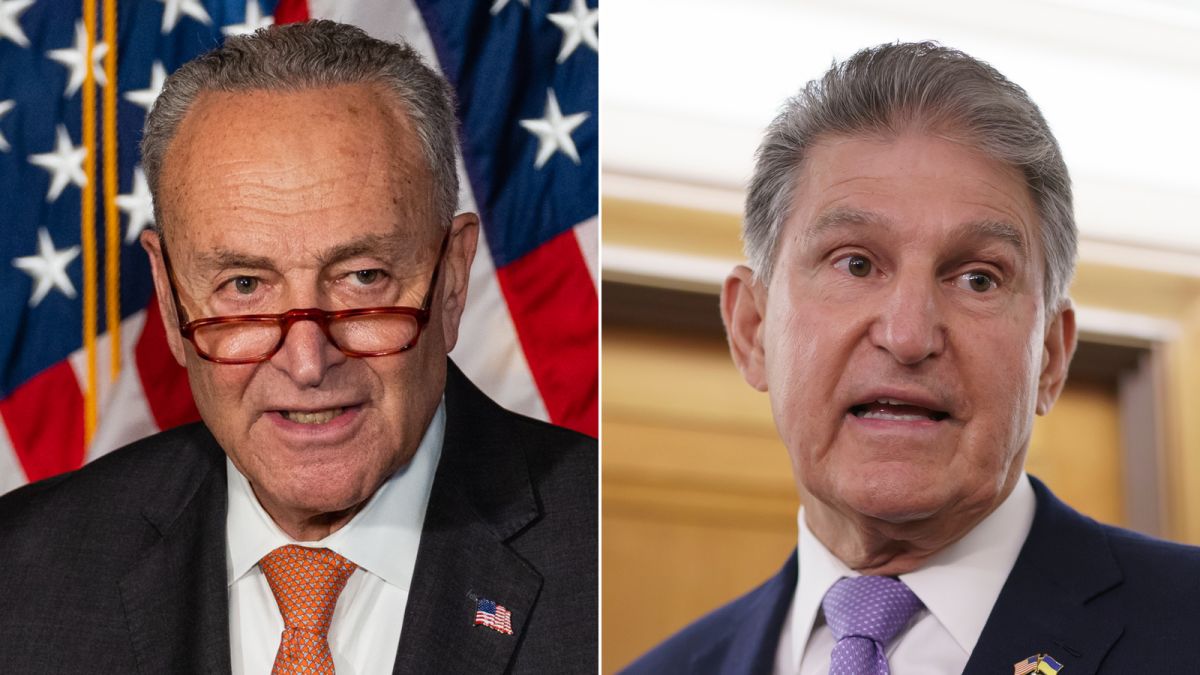


(CNN) - Senate Majority Leader Chuck Schumer and Sen. Joe Manchin on Wednesday announced a deal on an energy and health care bill, representing a breakthrough after more than a year of negotiations that have collapsed time and again.

But it will face furious GOP opposition.

The deal is a major reversal for Manchin, and the health and climate bill stands a serious chance of becoming law as soon as August -- assuming Democrats can pass the bill in the House and that it passes muster with the Senate parliamentarian to allow it to be approved along straight party lines in the budget process.

While Manchin scuttled President Joe Biden's Build Back Better bill, the final deal includes a number of provisions the moderate from West Virginia had privately scoffed at, representing a significant reversal from earlier this month. That includes provisions addressing the climate crisis.

The agreement contains a number of Democrats' goals. While many details have not been disclosed, the measure would invest $369 billion into energy and climate change programs, with the goal of reducing carbon emissions by 40% by 2030, according to a one-page fact sheet. For the first time, Medicare would be empowered to negotiate the prices of certain medications, and it would cap out-of-pocket costs at $2,000 for those enrolled in Medicare drug plans. It would also extend expiring enhanced subsidies for Affordable Care Act coverage for three years.

The announcement comes at a crucial time for Congress, as the Senate is a little over a week away from starting a monthlong recess, when many Democrats will campaign for reelection. The news also came several hours after the Senate passed a separate bill to invest $52 billion in US manufacturing of semiconductors, sending it to the House to consider as soon as this week.

Notably, Senate Minority Leader Mitch McConnell had previously vowed to try to halt passage of the semiconductor bill if Democrats continued to pursue their party-line bill on climate and drug prices.

Manchin's agreement represents reversal

Manchin's support is notable given his stance earlier this month that he "unequivocally" wouldn't support the climate or tax provisions of the Democratic economic package, which appeared to torpedo any hope Democrats had of passing legislation to fight climate change in the near future.

But Schumer and Manchin have been in revived talks since July 18 and locked down a deal Wednesday, according to a source familiar with the matter. Manchin had thrown cold water on doing tax and energy provisions as part of the deal, but ultimately agreed to it.

The White House has signed off on this deal, Biden said in a statement.

The deal still faces multiple hurdles before it can make it to Biden's desk, including the parliamentarian and having to pass both chambers of Congress, where practically any Democrat could sideline or delay passage.

Climate provisions 'could be a huge win'

In a statement, Schumer's office said the bill would reduce US carbon emissions by roughly 40% by 2030. Clean energy tax credits would drive the majority of those emission reductions, a Democratic aide said.

Two weeks ago, Schumer and Manchin were nearing a deal on $375 billion for the climate and energy provisions of the bill; the topline for climate announced tonight is $6 billion less than the original figure.

Still, a senior Democratic aide told CNN they were happy with the $369 billion figure on spending for the climate and energy portion of the bill, saying it was more funding than was expected to come out of a deal.

Tax credits for electric vehicles made it into the new deal, according to two Senate Democratic aides. Electric Vehicle tax credits will continue at their current levels, up to $4,000 for a used electric vehicle and $7,500 for a new EV.

However, there will be a lower income threshold for people who can use the tax credits -- a key demand of Manchin's. Manchin had been staunchly opposed to electric vehicle tax credits throughout negotiations.

Democratic Sen. Tina Smith of Minnesota told CNN that she was presiding over the Senate Wednesday evening when Schumer called to tell her he had reached a deal with Manchin on a climate and energy bill. As Smith was presiding, her phone kept ringing off the hook with an unlisted number, which was Schumer calling. Finally, she answered it.

"I knew it was Chuck; I did the complete no-no and answered the phone," Smith told CNN. "He said '40% emissions reductions by 2030, this is a big F-ing deal!'"

Smith, a Senate climate hawk, told CNN she was elated a deal had been reached after many ups and downs in negotiations with Manchin.

She said the agreement was the "most significant action on climate and clean energy we've ever taken."

"Everybody is very excited. I'm stunned but in a good way," Smith said.

Leaders of two prominent climate groups also told CNN the latest development was unexpected.

"This is not what anyone was expecting, but we are so excited it's back on," Tiernan Sittenfeld, the senior vice president of government affairs at the League of Conservation Voters, told CNN. "Obviously it's coming not a moment too soon as families struggle from the crazy heat across the world and country."

Advocates were awaiting more details on the climate provisions, expected to be released on Wednesday evening.

"We need to see the details of this deal, especially if there's permitting reform and development of fossil fuels," Evergreen Action co-founder Jamal Raad told CNN. "We're going to need to see in the coming days modeling on this legislation."

But if the package does indeed achieve the emissions reductions Schumer is promising, Raad said it would be a hugely important step.

"If this package does that in a bold way, this could put us on the path to reaching our goals and could be a huge win," he said.

Medicare drug price negotiation provisions remain in the bill

The deal keeps the prescription drug prices changes that Manchin had previously agreed to, including empowering Medicare to negotiate the price of certain costly medications administered in doctors' offices or purchased at the pharmacy. The Health and Human Services secretary would negotiate the prices of 10 drugs in 2026, and another 15 drugs in 2027 and again in 2028. The number would rise to 20 drugs a year for 2029 and beyond.

It would also redesign Medicare's Part D drug plans so that seniors and people with disabilities wouldn't pay more than $2,000 a year for medication bought at the pharmacy. And, the deal would require drug companies to pay rebates if they increase their prices in the Medicare and private-insurance markets faster than inflation.

Altogether, the drug price provisions would reduce the deficit by $288 billion over a decade, according to the Congressional Budget Office.

The agreement also calls for extending the enhanced Affordable Care Act subsidies for three years. An earlier deal would have continued the beefed-up subsidies for two years, which meant they would have expired just after the 2024 presidential election -- a scenario that congressional Democrats did not want to encounter.

The subsidies were expanded through this year as part of Democrats' $1.9 trillion coronavirus relief package, known as the American Rescue Plan, which was enacted in March 2021. They have made health care coverage on the Obamacare exchanges more affordable, leading to record enrollment this year.

Enrollees pay no more than 8.5% of their income toward coverage, down from nearly 10%. And lower-income policyholders receive subsidies that eliminate their premiums completely. Also, those earning more than 400% of the federal poverty level have become eligible for help for the first time.

Extending the enhanced subsidies would cost $64 billion over a decade, according to the CBO.

Paying for the bill

To raise revenue, the bill would impose a 15% minimum tax on corporations, which would raise $313 billion over a decade. While details on the current deal remain scant, the House version of the Build Back Better package would have levied the tax on the corporate profits that large companies report to shareholders, not to the Internal Revenue Service.

It would have applied to companies with more than $1 billion in profits and yielded a similar revenue-raising figure.

The current deal also aims to close the carried interest loophole, which allows investment managers to treat their compensation as capital gains and pay a 20% long-term capital gains tax rate instead of income tax rates of up to 37%.

Eliminating this loophole, which would raise $14 billion over a decade, has been a longtime goal of congressional Democrats.

The package also calls for providing more funding to the IRS for tax enforcement, which would raise $124 billion.

Democrats say families making less than $400,000 per year would not be affected, in line with a pledge by Biden. Also, there would be no new taxes on small businesses.

Manchin said in a statement that the deal would ensure "that large corporations and the ultra-wealthy pay their fair share in taxes," though it doesn't contain the tax rate hikes on rich Americans and big companies that Democrats initially wanted to include in the budget reconciliation packages before they were shot down by Democratic Sen. Kyrsten Sinema of Arizona.

Notably, Manchin also threw cold water on one of Schumer's priorities -- addressing the $10,000 cap on state and local tax deductions, known as SALT, that was part of the GOP tax cut package in 2017 and affects many states in the Northeast and on the West Coast.

Many details of the current deal remain to be worked out, which could delay or scuttle it, said Howard Gleckman, a senior fellow at the nonpartisan Tax Policy Center.

In total, Democrats say the deal would reduce the deficit by more than $300 billion.

"Rather than risking more inflation with trillions in new spending, this bill will cut the inflation taxes Americans are paying, lower the cost of health insurance and prescription drugs, and ensure our country invests in the energy security and climate change solutions we need to remain a global superpower through innovation rather than elimination," Manchin said in his own statement Wednesday afternoon.

https://www.cnn.com/2022/07/27/politics/schumer-manchin-deal-build-back-better/index.html

How secret negotiations revived Joe Biden's agenda and shocked Washington
https://www.cnn.com/2022/07/28/politics/manchin-schumer-biden-deal/index.html

Offline Rick Plant

  • Hero Member
  • *****
  • Posts: 8177
Re: U.S. Politics
« Reply #933 on: July 29, 2022, 07:23:52 AM »
President Biden @POTUS

My message to Congress is this:

The Inflation Reduction Act is the strongest bill you can pass to lower inflation, reduce costs, and tackle our climate crisis.

So pass it. Pass it for the American people – and pass it for America.

Let me be clear.

The Inflation Reduction Act of 2022 would be the most significant legislation in history to tackle the climate crisis and to improve our energy security.

Tune in as I deliver remarks on the Inflation Reduction Act of 2022.


Watch: https://twitter.com/i/broadcasts/1vOGwyjVNoWxB

Offline Rick Plant

  • Hero Member
  • *****
  • Posts: 8177
Re: U.S. Politics
« Reply #934 on: July 29, 2022, 07:28:47 AM »
Democrats Lead Big In Pennsylvania

A new Fox News poll in Pennsylvania finds John Fetterman (D) holds an 11-point lead over Mehmet Oz (R) in the U.S. Senate race, 47% to 36%.

In the race for governor, Josh Shapiro (D) leads Doug Mastriano (R) by 10 points, 50% to 40%.

https://politicalwire.com/2022/07/28/democrats-lead-big-in-pennsylvania/


Offline Rick Plant

  • Hero Member
  • *****
  • Posts: 8177
Re: U.S. Politics
« Reply #935 on: July 30, 2022, 01:27:21 AM »
Republicans do not care about our vets suffering from cancer. All they care about is sabotaging the Democrats agenda that the overwhelming majority of Americans want. So, Republicans were angry that Joe Manchin agreed to Biden's bill which will lower prescription drug prices for Americans which will be paid for by raising taxes on billionaires and corporations. In retaliation, Senate Republicans blocked an extremely important bill which helps our vet suffering from cancer. Republicans were fist bumping on the Senate floor because they blocked a bill to help our vets who are suffering from cancer out of spite. Remember in November.           

Jon Stewart smacks down Ted Cruz's 'BS' excuse for blocking veteran care bill


This week, Republican senators stunned the political world by coming together to block the PACT Act, a bipartisan bill that would give relief and survivor benefits to veterans who developed illnesses from exposure to toxic burn pits while stationed in Iraq and Afghanistan. Democrats have accused them of retaliating after Sen. Joe Manchin (D-WV) reached a reconciliation agreement with Democratic leadership.

Republicans have denied this is the reason, and Sen. Ted Cruz (R-TX) — who was seen high-fiving his colleagues after blocking the veteran bill — provided an alternate explanation to reporters. But according to The Daily Beast, comedian Jon Stewart, who has been fighting to pass burn pit care for years, called out his excuse as false.

"Cruz was at an airport earlier in the day when a TMZ correspondent cornered him to ask about Stewart’s crusade," reported MMatt Wilstein. "'He’s actually quite funny,' the Republican said of Stewart before claiming to support the PACT Act, even though he voted against it. With a Diet Dr. Pepper in his hand, Cruz went on to accuse the Democrats of playing a 'budgetary trick' by taking 'discretionary' spending and moving it to 'mandatory.'"

That's not true, said Stewart in colorful language.

"In response, Stewart called Cruz’s comments 'inaccurate, not true, bull***t' before systematically breaking down why his argument makes no sense," said the report. "'Now I’m not a big-city, Harvard-educated lawyer,' he said, 'but I can read. It’s always been mandatory spending, so the government can’t just cut off their funding at any point. No trick, no gimmick, been there the whole f****ng time ... This is bull***t,' Stewart reiterated, calling out Cruz for voting for the bill in June before joining a large block of Republicans who switched sides even though the text of the bill remained exactly the same."

"The comedian and activist closed out his message with the juxtaposition of Cruz 'praising to the heavens our nation’s fighting men and women' and a clip of him 'fist-bumping his Senate colleagues after removing those same veterans’ benefits and healthcare for toxic wounds,'" said the report. "'Mo*******er,' he concluded."


Video Shows Republicans Fist Bumping After Blocking Veteran Healthcare Bill


Republican Senators have been criticized for fist bumping on the Senate floor after the GOP blocked a bill that would have expanded healthcare coverage for military veterans exposed to toxic burn pits during their service.

On Wednesday night, the Senate failed to pass a Sergeant First Class Heath Robinson Honoring Our Promise to Address Comprehensive Toxics (PACT) Act in a 55 to 42 vote.

All but one of the 42 Senators who voted against the bill were Republicans, including 25 who previously supported it in June. The Senate had to vote for the PACT Act again because of a technical change the House made to the bill.

After the vote, a group of Republican Senators were seen shaking hands on the chamber floor, with Texas' Ted Cruz and Montana's Steve Daines also giving each other a fist bump.

A clip of the pair bumping fists was shared on Twitter by the Senate Democrats, along with the caption: "Senate Republicans BLOCKED the PACT Act, critical health care for veterans with illness caused by toxic burn pits.

"Even though many Republicans supported it just weeks ago. And they celebrated."

The clip has been viewed more than one million times since it was posted on Twitter.

The Montana Democrat Party shared a similar video along with the caption "Steve Danies BETRAYED sick veterans and CELEBRATED it with a fist bump.

"This is how Daines treats our veterans. It's a game to him."

MSNBC's Chris Hayes said the GOP Senators decided to vote against what was previously a "broadly bipartisan" bill to help war veterans in retaliation for the Democrats waiting for the CHIPs Act to pass before revealing that Joe Manchin and Chuck Schumer had come to an agreement on what was essentially the long-negotiated Build Back Better Act.

In June, Senate Minority Leader Mitch McConnell threatened that the GOP would not help pass the CHIPs Act if Democrats went forward with the reconciliation package, a statement he made while Manchin was still objecting to it.

"Republicans were not happy, they threw a temper tantrum," Hayes said Thursday night. "They feel like they got played, so they're looking around with their anger, who to take it out on, and what they did was—I'm not making this up—they decided to punish U.S. war vets suffering the aftereffects of toxic fumes."

Hayes then played the clip of Cruz and Daines fist bumping as the "no" votes were being read out.

"'We'll show them, those vets whose lungs have the effects of toxic fumes they inhaled while fighting our wars.' Truly shameless stuff," Hayes added.

In a statement to Newsweek, a spokesman for Cruz said: "Senator Cruz is a strong supporter of the PACT Act and our nation's veterans. However, this version of the PACT Act contains an irresponsible Democratic provision allowing Congress to recklessly spend an additional $400 billion on programs totally unrelated to our veterans.

"The Senator and his Republican colleagues are working to advance the bill while removing that provision. Democrats were aware of this concern before yesterday's vote but ignored it and refused to allow a vote to fix the bill.

"That refusal is why the bill is currently stalled. Democrats must work with Republicans and fix this issue to prevent inflationary spending that will hurt all Americans. Once that happens, the PACT Act will quickly become law."

Daines has been contacted for comment.

Watch Video Here: https://twitter.com/i/status/1552773816027418625

https://www.newsweek.com/gop-fistbump-pact-senate-military-ted-cruz-steve-daines-1729031

Offline Rick Plant

  • Hero Member
  • *****
  • Posts: 8177
Re: U.S. Politics
« Reply #936 on: July 30, 2022, 10:28:01 AM »
Joe Manchin and Chuck Schumer Have a Surprise for You

An 18-month odyssey culminates in a smaller-than-promised, bigger-than-expected agreement to lower health care costs, tax corporations, and protect the planet.


Five years ago today, the late John McCain strode onto the Senate floor and delivered a thumbs-down to the Republican repeal of Obamacare, a white whale they had been pursuing since well before obtaining a governing trifecta. The legislative agenda in the Trump years narrowed to a historically unpopular tax cut and deregulation.

One year ago today, Chuck Schumer and Joe Manchin signed a secret deal to deliver a $1.5 trillion reconciliation bill that would include “no additional handouts or transfer payments” on any health or family care policies, and investments in “fuel neutral” energy, with carbon-capture technologies mandated for fossil fuel infrastructure, a zero-emission vehicle credit that included hydrogen fuel cell cars, with parity for both renewable and fossil fuel tax credits. Among the measures to help pay for it were a corporate minimum tax of 15 percent and an end to the carried interest loophole.

For 364 days, Manchin went back and forth on pretty much all of these provisions, rejecting the bill outright, then crawling back to the table, going into bargaining with Schumer, leaving that bargaining, and coming back. And one year to the day later, we have a bill called the Inflation Reduction Act of 2022, which includes everything in that previous paragraph and a lot more on energy and climate, plus the ACA insurance exchange subsidies and prescription drug price reforms we knew about. But overall, the bill spends $433 billion, a little over $1 trillion less than that original topline. Much of its revenue goes to deficit reduction.

There is no such thing as a genuine surprise in Washington—usually. This was a genuine surprise. I had been talking to people this week who would or should have known that talks between Manchin and Schumer, thought to be moribund, were taking place. The closest I got to foreknowledge was one source saying that they just didn’t believe it. An army of reporters, lobbyists, and hangers-on didn’t know this was happening.

The reveal was made a few hours after the Senate cleared the CHIPS and Science Act, a bill that offers semiconductor manufacturers subsidies for reshoring and boosts science programs. Mitch McConnell had threatened that bill, something highly cherished by Schumer, if Democrats persisted with a party-line bill that raised taxes and boosted clean energy. When Manchin walked away from negotiations with Schumer just two weeks ago over those two items, McConnell let his guard down and allowed a vote on CHIPS, which was popular with many of his Republican colleagues. Schumer and Manchin waited until that cleared the Senate before announcing a reconciliation deal with taxes and climate back in.

If you told me a cosmic ray hit Washington and flipped everyone’s brains, giving Schumer the Machiavellian cunning of a Republican and giving McConnell the guileless approach of a Democrat, that might be a more plausible explanation for this display than the truth. It’s a near-legendary turn of events that infuriated McConnell so much he took hostage a bill to give dying veterans exposed to toxic burn pits medical care, something Republicans passed overwhelmingly just a few weeks ago (it needed a technical fix). The combination of the revival of the Biden agenda and red-faced Republicans making terrible choices on highly popular legislation is one for the ages.

We’ll get to the details, which are critical, and the lingering opportunities for failure, which are real, in a minute. But in the interest of full disclosure, I personally thought it was no longer worth bothering with Manchin anymore after he walked away yet again and offered only the ACA/drug pricing remnants as what he could accept. Time and again in this interminable process, Manchin was asked what he could accept, by Schumer, by Biden, and he’d just change his mind, from day to day and week to week. It was impossible to get a straight answer, or one that stuck for more than a day or so. And so I thought it was time to cut bait.

But Manchin did not. According to his interview with Politico last night, it took him all of four days after killing the deal to ask Schumer to restart it. What happened in that time? Manchin was clearly bothered by being blamed, by everyone, as the man who let the Biden agenda die and the planet burn. The very next day, he went on local radio and insisted he hadn’t ended anything, that he just wanted to see the July inflation numbers (which won’t be out for a couple more weeks). He was attacked, in op-eds that detailed “What Joe Manchin Cost Us” (written by a lead technical adviser to the Democrats on climate policy), in news stories that made very clear who was responsible. Green groups and particularly blue/green labor/environment groups were insistent. Larry Summers told him in a meeting that his rationale that climate investment and tax increases were inflationary was nonsense.

Now, I was calling out Manchin’s disingenuousness on inflation and public investment as far back as last September. But Joe Manchin isn’t supposed to listen to someone like me. His Achilles’ heel was elite accountability. He didn’t want to be targeted by elites as the bad guy, the man who dashed Democratic hopes, alone, by himself. Past wavering from Manchin had some elite buy-in, that he was just mad about “gimmicks” in the spending package, or that the inflation claims had some validity. That was not the case here. And Manchin wilted under that pressure. There was an inside-outside game that succeeded.

The irony is that many, many, many millions of dollars were spent trying to prop up Build Back Better in very traditional ways, when all that was needed was prime placement in the op-ed pages Manchin reads to make him uncomfortable.

Now, all that said: What’s in the bill, and was it worth the agita? The health care piece has already been covered: extending the subsidies that make insurance affordable in the Affordable Care Act (for three years, beyond the end of this presidency, which is important), combined with an exceedingly modest drug price reform that still yields $288 billion in Medicare savings and more for individual seniors, is fine. The Democrats should find a way to get insulin back into the mix, rather than leaving it out so a bipartisan bill can fail.

The tax measures are simple. There’s a corporate alternative minimum tax for companies with more than $1 billion in annual profit. It’s based loosely on Elizabeth Warren’s book profits tax from the 2020 campaign, which derived profit from financial statements to investors, not deduction-heavy tax filings; however, it seems like some credits will be able to count against profits, meaning more savings for corporations. There’s also an $80 billion investment in the IRS that CBO believes will raise $124 billion in revenue on net (the Biden administration thinks it will be much higher), and a tweak, not a closure, of the carried interest loophole.

As Victor Fleischer explains, that tweak really just extends the “holding period” where income is treated as capital gains (with a lower tax rate) from three to five years. So if a private equity fund owns an asset for more than five years before selling, they get the lower tax rate. Often portfolio companies are held for longer than that. Regulations could strengthen this, but the tweak only adds $14 billion over ten years, and you could easily see it having been put in so it can be taken out later.

There’s also a nice $15 million pilot program to study a direct e-file tax return system, administered by the government instead of private tax preparers like Intuit. The administration has a keen interest in that one.

As for the climate and energy measures, you will hear a lot that this is the largest climate action taken by the U.S. government in history. Those statements often tell you nothing, because it’s a “compared to what” scenario. On its own terms, this narrows energy investment from $550 billion in the initial Build Back Better Act to $369 billion, though a “climate bank” and “climate accelerator” could allow for another $290 billion in investment from the private sector. This is mostly achieved through scaling back the credits; included in that number is an “all of the above” energy strategy with incentives for fossil fuel production (with carbon capture), offshore oil and gas (with a larger royalty payment), biofuel production, and more. This was of course the only way to get Manchin’s buy-in, a trade of sustaining carbon emissions (hopefully slightly cleaner ones) for the green transition.

I don’t have a full breakdown of how much of that $369 billion is for cleantech, but there are hundreds of billions enumerated in the topline summary, and that doesn’t include the electric-vehicle benefit, which is $4,500 for used vehicles and $7,500 for new ones, up to fixed income limits, and available at point of sale. Other things climate hawks have pointed out include $60 billion in environmental justice provisions (neighborhood block grants, along with port pollution reduction), manufacturing tax credits for renewables, energy efficiency subsidies, a methane leakage fee, and $5 billion in grants to utilities to decarbonize, as well as a direct-pay credit for public power facilities.

Manchin also secured a promise from leadership for unspecified “permitting reform” by the end of September. (This is apparently mainly so the natural gas Mountain Valley Pipeline that runs through West Virginia can get approved.) This creates an interesting new “two-track” strategy, where Manchin wants the thing that will come later (permitting) instead of the thing that will come first (the Inflation Reduction Act). Progressives could certainly stiff Manchin on the permit stuff, though they’d be under pressure not to, and Republicans could vote to deregulate permitting and make progressives irrelevant.

As ever, it’s not over. Schumer wants to put this on the floor next week. The measures were all things Kyrsten Sinema previously supported, but she was blindsided by the deal and hasn’t firmly said she’s on board. Bob Menendez, who has been a quiet problem on several elements of the bill, got louder on Wednesday, saying that the restoration of the state and local tax (SALT) deduction should get into the final version. Other SALT fans lurk in the House, where Nancy Pelosi only has four votes to spare, but they were less insistent than Menendez.

It’s hard to predict anything in this situation anymore, but the potential holdouts are much more tied to the Democratic establishment structure than Manchin, so the odds lean toward it working out, though not necessarily sharply.

So what’s the final verdict? It’s nothing short of a miracle that Manchin came back to the bargaining table, thanks to an inside-outside game that was one of the few examples of smart tactical strategy in the past two years. The result is about one-ninth of the spending and less than half of the revenue of the initial Biden agenda vision.

But all that spending couldn’t carry its own weight. As I said last October in The New York Times, it would be far superior to do a few less things and do them well. Laying out a climate, health care, and tax bill in March 2021 would have saved a year-plus of heartache. Squishing the entire agenda into one bill, and significantly worsening those pieces so they could fit, was a bad idea. This isn’t a perfect one either. It is what the system could bear, and it got the big thing—a plan to protect the planet from the worst ravages of global heating—about 80 percent right.

https://prospect.org/politics/joe-manchin-and-chuck-schumer-have-a-surprise-for-you/

Offline Rick Plant

  • Hero Member
  • *****
  • Posts: 8177
Re: U.S. Politics
« Reply #937 on: July 30, 2022, 10:32:37 AM »
US House votes to ban assault weapons as Republicans criticize ‘gun grab’

The House has passed legislation to revive a ban on semi-automatic guns, the first vote of its kind in years and a direct response to the firearms often used in the crush of mass shootings ripping through communities nationwide.

Once banned in the US, the high-powered firearms are now widely blamed as the weapon of choice among young men responsible for many of the most devastating mass shootings. But Congress allowed the restrictions first put in place in 1994 on the manufacture and sales of the weapons to expire a decade later, unable to muster the political support to counter the powerful gun lobby and reinstate the weapons ban.

Speaker Nancy Pelosi pushed the vote toward passage in the Democratic-run House, saying the earlier ban had “saved lives”.

The House legislation is shunned by Republicans, who dismissed it as an election-year strategy by Democrats. Almost all Republicans voted against the bill, which passed 217-213. It will probably stall in the 50-50 Senate.

The bill comes at a time of intensifying concerns about gun violence and shootings – the supermarket shooting in Buffalo, New York; massacre of school children in Uvalde, Texas; and the Fourth of July shooting of revelers in Highland Park, Illinois.

Voters seem to be taking such election-year votes seriously as Congress splits along party lines and lawmakers are forced to go on the record with their views. A recent vote to protect same-sex marriages from potential supreme court legal challenges won a surprising amount of bipartisan support.

Joe Biden, who was instrumental in helping secure the first semi-automatic weapons ban as a senator in 1994, encouraged passage, promising to sign the bill if it reached his desk. In a statement before the vote, his administration said: “We know an assault weapons and large-capacity magazine ban will save lives.”

The Biden administration said for 10 years while the ban was in place, mass shootings declined. “When the ban expired in 2004, mass shootings tripled,” the statement said.

Republicans stood firmly against limits on ownership of the high-powered firearms during an at times emotional debate ahead of voting.

“It’s a gun-grab, pure and simple,” said Guy Reschenthaler of Pennsylvania.

Said Andrew Clyde of Georgia: “An armed America is a safe and free America.”

Democrats argued that the ban on the weapons makes sense, portraying Republicans as extreme and out of step with Americans.

Jim McGovern of Massachusetts said the weapons ban was not about taking away Americans’ second amendment rights but ensuring that children also had the right “to not get shot in school”.

National gun violence prevention organizations are describing the House’s actions as a promising step toward getting future restrictions passed at the federal level.

“Just a few years ago this would have been unthinkable,” said Trevon Bosley, a board member of March for Our Lives. The organization was born after a young gunman shot and killed 17 students and staff of Marjory Stoneman Douglas High School in Parkland, Florida.

“This bill won’t save lives yet, but it does send a powerful message to the millions of young people who are growing up fighting for our lives: change is possible.”

The bill would make it unlawful to import, sell or manufacture a long list of semi-automatic weapons. Jerry Nadler, chair of the judiciary committee, said it exempts those already in possession.

Since the previous ban expired nearly two decades ago, Democrats had been reluctant to revisit the issue and confront the gun lobby. But voter opinions appear to be shifting and Democrats dared to act before the fall election. The outcome will also make candidates’ stance on gun legislation clear ahead of the midterm elections.

Congress passed a modest gun violence prevention package just last month in the aftermath of the tragic shooting of 19 school children and two teachers in Uvalde. That bipartisan bill was the first of its kind after years of failed efforts to confront the gun lobby, including after a similar 2012 mass tragedy at Sandy Hook elementary school in Newtown, Connecticut.

That law provides for expanded background checks on young adults buying firearms, allowing authorities to access certain juvenile records. It also closes the so-called “boyfriend loophole” by denying gun purchases for those convicted of domestic abuse outside of marriages.

The new law also frees up federal funding to the states, including for “red flag” laws that enable authorities to remove guns from those who would harm themselves or others.

But even that modest effort at halting gun violence came at time of grave uncertainty in the US over restrictions on firearms as the more conservative supreme court is tackling gun rights and other issues.

Biden signed the measure two days after the supreme court’s ruling striking down a New York law that restricted people’s ability to carry concealed weapons.

https://www.theguardian.com/us-news/2022/jul/29/us-house-assault-weapons-ban-bill-senate